Everyone who wants to learn finger drumming asks the same question before they start: how long to learn finger drumming well enough that it actually sounds like music?
Not "how long in theory." Not "how long if I practice eight hours a day." How long before a groove sounds like a groove instead of someone hitting pads in the rough shape of a beat. This article documents what finger drumming progress looks like across 30 days of consistent, structured practice — the specific milestones, the specific wall where most people quit, and what gets you past it.
What's Inside This Guide
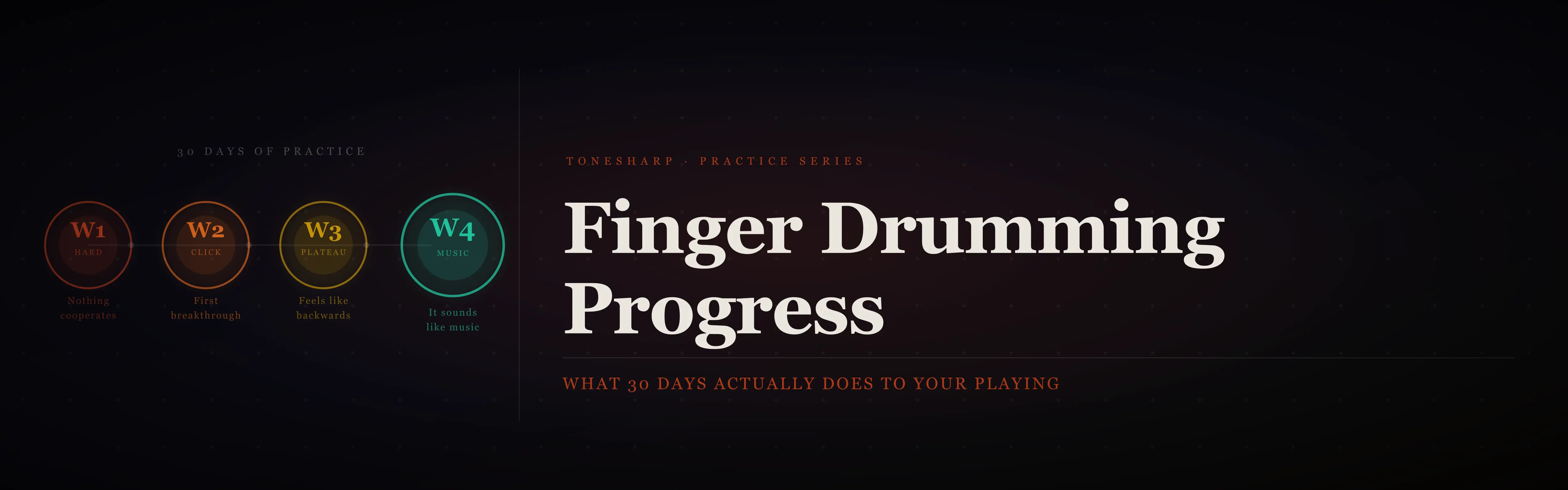
Week 1: When Nothing Works

The honest answer to how long to learn finger drumming is that the first week feels like the answer is “never.”
Your hands do not cooperate. The kick and hi-hat running simultaneously feel neurologically impossible. You can’t do each one alone. The moment you try to add the second, the first falls apart. You slow down and it almost works. You speed up and it collapses. You repeat this for 15 minutes and wonder if you’re missing something everyone else has.
You’re not. This is what Week 1 feels like for every finger drumming beginner. The brain is building a coordination pathway that does not yet exist. That takes repetition before it takes smoothness. There is no shortcut and no technique that bypasses this stage.
What to focus on in Week 1: Single exercises only. Kick and hi-hat at 60 BPM until that specific combination starts feeling less effortful — even slightly. Do not add the snare. Do not try to play a full groove. The first two exercises in the beginner guide are the entire Week 1 curriculum. Finish those before moving on.
The people who quit in Week 1 quit because they try to play grooves before their hands can run two elements independently. They hear the gap between what they’re playing and what they want, conclude they’re not built for this, and stop. The gap is real. The conclusion is wrong.
Week 2: The First Breakthrough

Somewhere in Week 2 — for most people around day 8 or 9 — the kick and hi-hat start running without conscious direction. It happens mid-session, usually unexpectedly. You realise you have been playing the pattern for 30 seconds without thinking about it. That is the first real finger drumming progress milestone.
It won’t be consistent yet. Some sessions it clicks, others it doesn’t. That inconsistency is normal and does not mean the progress has reversed — it means the neural pathway is still consolidating. The days where it falls apart are not regressions. They are part of the same process.
By the end of Week 2, on a good day, the basic three-element groove — kick on 1 and 3, snare on 2 and 4, hi-hat on every 8th note — becomes automatic. Not clean. Not musical. But automatic, which is a different thing and the more important one.
What to focus on in Week 2: Consistency of practice time, not complexity. Fifteen minutes every day beats 90 minutes twice a week for building the coordination pathways that finger drumming depends on. The 15-minute practice routine is the right structure for this stage. Every session: warm-up, focused drill on the groove skeleton, three minutes of free playing.
Week 3: The Plateau

Week 3 is where finger drumming beginners most commonly quit for the second time. The reason is specific: after the breakthrough of Week 2, Week 3 feels like you are going backwards. Patterns that were working now feel shaky. Tempos that felt comfortable now feel fast. The groove you were proud of on Day 12 sounds worse on Day 16.
This is not regression. It is neurological consolidation — the brain reorganising the coordination built in Week 2 into a more efficient structure. The messiness is part of the process. Every skill requiring complex motor coordination goes through this phase, and it typically lasts 5–7 days.
The people who push through Week 3 report that what comes out the other side is qualitatively different — more stable, more automatic, more flexible. The people who stop conclude they peaked in Week 2. The plateau is temporary and the floor is rising even when the ceiling feels lower.
What to focus on in Week 3: Drop your tempo to 70% of your current best and add ghost notes. The slowdown forces your hands to be precise rather than just fast enough. Ghost snares — PAD hits at 20–30% of your normal snare volume — on the “e” of beat 1 and the “e” of beat 3. This is Exercise 5 from the beginner exercises post. The ghost notes give your brain a new technical problem to solve during consolidation, which is more productive than pushing speed.
Week 4: When It Sounds Like Music

Week 4 is the payoff. Not the end of learning — there is no end — but the first time the groove sounds like a groove rather than an exercise.
The specific thing that changes in Week 4 is velocity variation. In Weeks 1 through 3, every hit is approximately the same volume because your hands are focused entirely on landing the right pad at the right time. In Week 4, with the basic coordination running on autopilot, your hands begin to respond to the music rather than just execute the pattern. Hits vary in weight. The groove starts to breathe.
A second thing changes: you begin to hear what is missing instead of only hearing what you can play. In the first three weeks, your internal reference was the pattern you were trying to execute. In Week 4, your reference shifts to how the groove actually sounds. You notice when it’s stiff, when the snare is too loud, when the hi-hat rushes. That critical ear is finger drumming progress — it means the technical foundation is stable enough that your attention has moved to musicality.
What to focus on in Week 4: Play longer loops without stopping. Four bars, eight bars, sixteen bars. The goal is not to add elements — it is to sustain what you have built for longer without the pattern breaking down. Record yourself. The gap between how it feels to play and how it sounds on playback is informative and usually smaller than you expect.
What Comes Next

Thirty days of structured finger drumming practice does not make you an advanced player. It makes you someone who can play a real groove, hear what it needs, and practice it deliberately — the foundation everything else is built on.
The natural next step is expanding your vocabulary across genres. Boom bap, trap, funk, Latin, drum & bass, and jazz each introduce different rhythmic problems that build coordination and musical range far faster than repeating the same basic groove. The Week 1 fundamentals series covers the beginning of that journey.
If you want a structured path rather than figuring out what to practice next on your own, the free practice pack below has the first week of exercises — interactive pad player, notation, MIDI file, and 16 drum samples. Drop your email and it’s yours.

Related
- 15-Minute Finger Drumming Practice Routine
- First 5 Finger Drumming Exercises
- Week 1 — First Week of Finger Drumming
Thirty days. The hands that felt impossible in Week 1 are playing something musical in Week 4. The only variable is whether you showed up in between.
— ToneSharp