Boom bap sampled jazz records. Funk grew out of jazz rhythm sections. The Amen break's syncopation traces back to bebop. Every genre in this series has jazz's fingerprints somewhere inside it.
Week 12 goes to the source. The ride cymbal replaces the hi-hat as primary timekeeper. The kick becomes a whisper. The snare stops living on fixed positions and starts responding to the music. The 8th note no longer lands exactly where the grid says it does.
What's Inside This Guide
🎯 Week 12 Warm-Up: Ride Cymbal and Independence Drills

Jazz requires three things simultaneously that no previous week has combined: a steady ride hand, a hi-hat foot keeping independent time, and a snare hand free to comp anywhere it chooses.
Warm-Up 1: Ride Cymbal 8th Notes
The ride cymbal is jazz's clock. Unlike the hi-hat — which closes and opens — the ride sustains and resonates. Your right hand lives here for the entire groove.
What you're doing: Right hand only, 8th notes on PAD3. The hits should feel weighted, not tapped — like pressing into the cymbal rather than striking it. Start at 70 BPM.
Practice for 2 minutes. Every hit the same weight, the same tone. Unevenness in the ride hand means everything built on top of it will drift.
💡 Swing Note: The pad player sequences notes straight. Real jazz swing stretches the "and" of each beat to the last third of a triplet — it lands late, not halfway. These grids show where notes go. The when is in your feel. Practise alongside a jazz backing track set to swing.
Warm-Up 2: Hi-Hat Foot on 2 and 4
In jazz the hi-hat foot closes on beats 2 and 4, keeping a second layer of time independent from the ride hand. This is not an optional style choice — it is the genre's second clock.
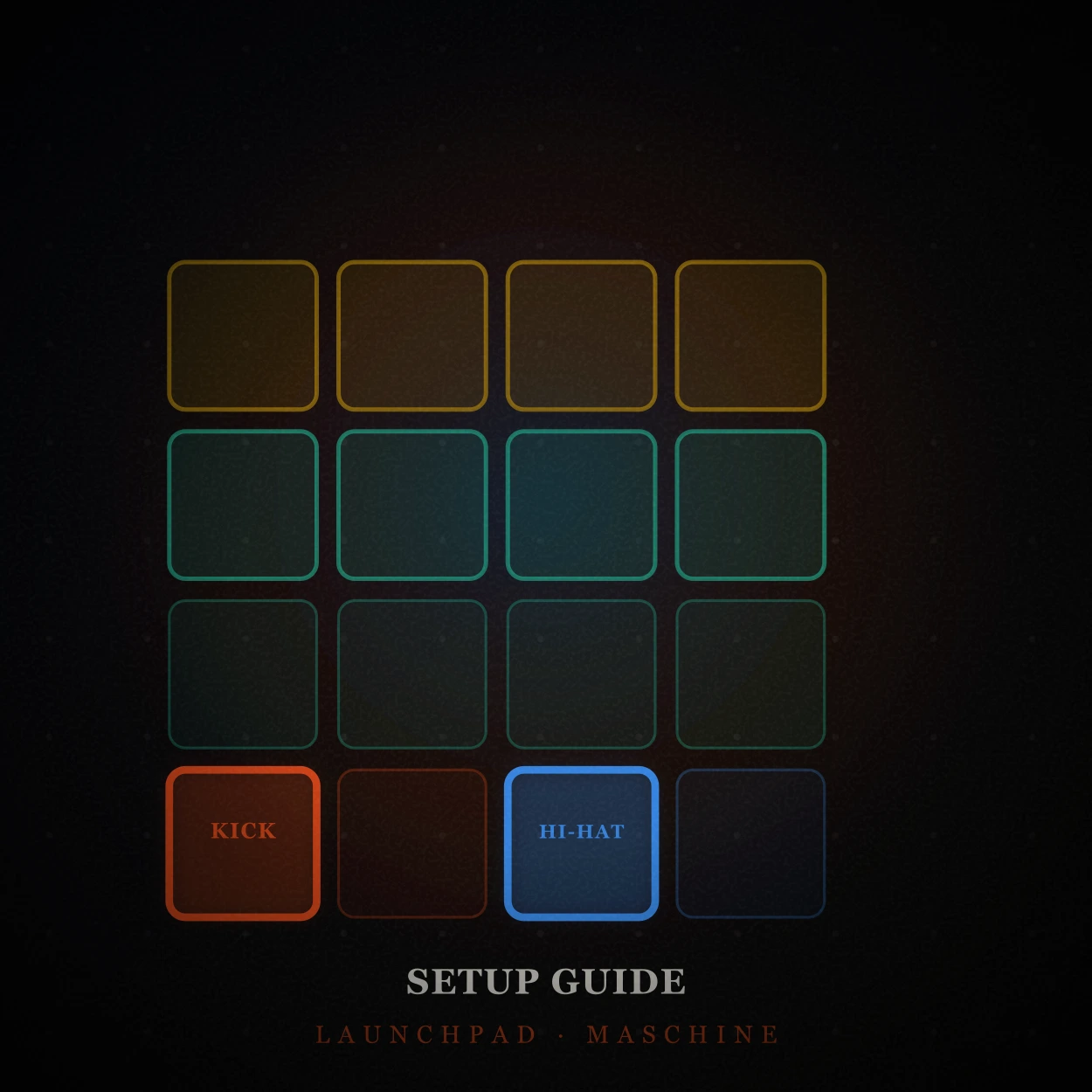
What you're doing: PAD2 on beats 2 (step 5) and 4 (step 13). Beat 1 kick as an anchor. Run both simultaneously.
Practice for 2 minutes. Hi-hat foot must not rush or drag against the kick. Beat 1 kick and beats 2&4 hi-hat are the groove's skeleton before the ride or snare enter.
Warm-Up 3: Ride + Hi-Hat Foot Independence
Now combine: right hand on the ride, left foot on the hi-hat, left hand free. This three-limb independence is what makes jazz physically demanding.
Practice for 3 minutes. Ride must not flinch when the hi-hat foot closes. If it stutters on beats 2 and 4, slow to 60 BPM and rebuild.
🎯 What Is Jazz Swing?
Jazz drumming as a distinct style solidified in the 1940s bebop era — Charlie Parker, Dizzy Gillespie, Kenny Clarke, Max Roach. The defining shift: the ride cymbal replaced the hi-hat as the primary timekeeping surface. The hi-hat foot kept time on 2 and 4. The snare was liberated from the backbeat to comp — to punctuate, respond, and converse with other musicians.
Swing subdivision is the genre's foundational concept. In straight time, 8th notes divide a beat exactly in half. In swing, they follow a triplet ratio — the "and" lands on the final third of the beat, not the halfway point. Written notation looks identical to straight 8ths. The feel is completely different. This is why jazz cannot be fully represented in a sequencer grid — it must be heard and internalised from recordings.
The feathered kick is jazz's other defining characteristic. Unlike every genre in this series, jazz kick is barely audible — a soft pulse on beat 1, sometimes omitted entirely. Its job is to add warmth to the bass register, not to anchor the groove.
What connects jazz to everything you've played: the snare comps instead of backbeats. That freedom is the vocabulary every other genre simplified into fixed patterns.
📚 Study These First
What to listen for: the ride cymbal as the dominant rhythmic voice, the hi-hat foot closing on 2 and 4 (audible as a softer click under the ride), the kick as a felt presence rather than a heard one, and how the snare appears in unexpected places without ever disrupting the ride's flow.
- "So What" by Miles Davis, feat. Jimmy Cobb (Kind of Blue, 1959, ~136 BPM) — The textbook jazz ride pattern. Jimmy Cobb's ride is completely audible. Count the 8th notes and feel how the "ands" lean late. The snare enters sparingly, always serving the phrase.
- "Autumn Leaves" by Bill Evans Trio, feat. Paul Motian (Waltz for Debby, 1961, ~132 BPM) — Paul Motian's brushwork and ride is one of the most studied in jazz. Listen for the hi-hat foot on 2 and 4 underneath — it never stops.
- "Moanin'" by Art Blakey & the Jazz Messengers (1958, ~214 BPM) — Jazz at a faster tempo. Art Blakey's ride is relentless. The snare comps aggressively. Everything still swings.
Start with "So What." Isolate the ride before anything else.
🥁 Pattern 1: Basic Jazz Groove (Beginner)
Ride 8th notes, snare on beats 2 and 4, feathered kick on beat 1. The simplest jazz groove — and the hardest to make feel right.
What you're learning:
- Ride cymbal as primary timekeeper — 8th notes, every beat, unwavering
- Snare on beats 2 and 4 (steps 5 and 13) — lighter than a boom bap backbeat
- Feathered kick: beat 1 only (step 1) — barely audible, just a suggestion
Tempo: 70 BPM. Jazz feel cannot be rushed into existence. The swing subdivision needs space to breathe.
Practice Strategy
- Ride alone — 3 minutes until the 8th note flow is automatic
- Add hi-hat foot — beats 2 and 4 underneath without disrupting the ride
- Add snare — same positions as hi-hat foot, lighter than you think
- Add feathered kick — beat 1 only, at 40% volume
💡 Key Insight: The snare in jazz is not a backbeat — it's a suggestion. If it sounds like boom bap with a different cymbal, the snare is too loud and too stiff. It should punctuate, not anchor.
🥁 Pattern 2: Snare Comping (Intermediate)
The ride stays constant. The snare moves — beat 2 (step 5), "and" of beat 3 (step 11), beat 4 (step 13). The kick expands to beats 1 and 3, feathered throughout.
What changes:
- Snare comp: beat 2 (step 5), "and" of beat 3 (step 11), beat 4 (step 13)
- Kick on beats 1 and 3 (steps 1 and 9) — still feathered, still quiet
- Ride never changes — the comp lives inside its continuity
Tempo: 80 BPM. The "and" of beat 3 (step 11) is the critical element — it must not rush toward beat 4.
Practice Strategy
- Snare comp alone — three positions in isolation, 2 minutes. Feel the space between step 11 and step 13
- Ride + snare comp — the hardest step. Ride must not skip when the snare hits on the same 8th note position
- Add feathered kick — beats 1 and 3, barely pressed
🎯 Advanced Challenge: Ghost Note Layer
Pattern 2 with ghost snares on the "e" of beat 1 (step 2) and the "e" of beat 3 (step 10) — the whispered layer beneath the comp that gives the groove its textural density. Kick pulls back to beat 1 only.
Only attempt this when Pattern 2 is clean at 80 BPM.
Ghost snares (PAD4) at 20–30% volume — quieter than any ghost note in this series. In jazz the ghost layer should be felt by the listener, not consciously heard. If someone can identify the ghost hits on first listen, they are too loud.
📈 7-Day Practice Plan
Days 1–2: Ride Foundation
- Tempo: 65–75 BPM
- Focus: Warm-Ups 1 and 2 daily — ride hand alone, then hi-hat foot added. Pattern 1 ride alone before anything else
- Goal: Full Pattern 1 clean at 75 BPM with swing backing track — ride even, snare light
Days 3–4: Comping Introduction
- Tempo: 75–85 BPM
- Focus: Snare comp positions in isolation, then ride + comp without kick
- Goal: Pattern 2 skeleton clean at 80 BPM — "and" of beat 3 landing precisely
Days 5–6: Full Patterns + Ghost Notes
- Tempo: 80–90 BPM
- Focus: Full Pattern 2 with kick. Attempt Advanced if Pattern 2 is stable
- Goal: Advanced pattern clean at 85 BPM — ghost notes inaudible but felt
Day 7: Full Series Rotation
- Tempo: 85–90 BPM
- Practice: 4 bars boom bap → 4 bars funk → 4 bars clave → 4 bars Afrobeats → 4 bars two-step → 4 bars jazz. Continuous
- Goal: Six genres — clean switching. This is what a complete rhythmic vocabulary sounds like
💡 Common Mistakes & Quick Fixes
Mistake #1: Playing Swing Straight
Problem: The "and" of each beat lands exactly halfway — straight 8th note feel. The groove sounds mechanical.
Fix: Listen to "So What" and clap along to just the ride. Don't count — clap. Your body finds the swing before your brain does.
Mistake #2: Kick Too Heavy
Problem: The kick lands at full boom bap weight, turning the groove into something else entirely.
Fix: Press the pad at 30–40% power. If someone can hear it clearly across the room, it's too loud.
Mistake #3: Snare Overcomping
Problem: The snare plays too many positions, cluttering the space the ride needs to breathe.
Fix: Pattern 2's three-hit comp is already busy. Master restraint before adding. The most musical comp leaves more space than it fills.
Mistake #4: Ride Hand Flinching
Problem: The ride stutters when the snare or kick play — hands not yet independent.
Fix: Warm-Up 3 daily. Once the ride runs on autopilot, the other limbs can move without disturbing it.
🔄 What You've Built This Week
- ✅ Ride cymbal timekeeping — 8th notes, steady, weighted, the groove's foundation
- ✅ Hi-hat foot independence — beats 2 and 4 while the ride hand keeps moving
- ✅ Feathered kick — beat 1 as suggestion, not statement
- ✅ Snare comping — off the backbeat, responding rather than anchoring
- ✅ Six-genre vocabulary — boom bap, trap, funk, Latin/Afrobeats, drum & bass, jazz. The complete arc.
🎯 Next Week Preview
Week 13 brings hybrid groove and style fusion — combining elements from all six genres into original patterns. Jazz comping over a D&B kick. Clave with boom bap snare. Your vocabulary is now material to compose with.
🎁 Free Practice Resources
Twelve weeks in. Structured materials for Weeks 1–6 are in the free course below.
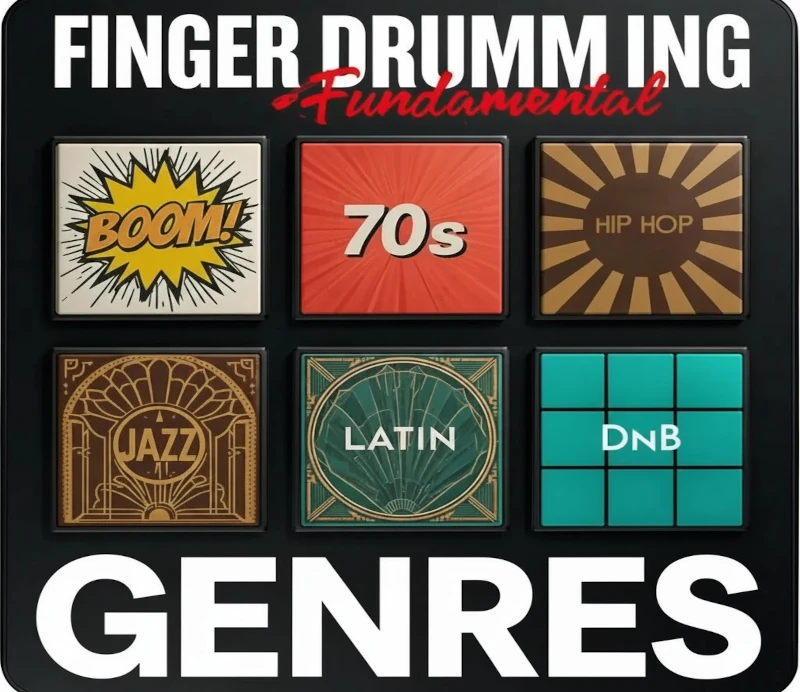
The patterns from this post — and all six genre lessons — are in the free Finger Drumming Fundamental Genres pack: standalone pad player, MIDI file, PDF notation and tablature, and 16 drum samples. Drop your email and it's yours instantly. For the full catalogue of lesson packs see Free Finger Drumming Lessons.
Every genre you've played for eleven weeks borrowed something from here. Jazz didn't simplify for the audience. It trusted the listener to meet it. Play with that trust.
— ToneSharp