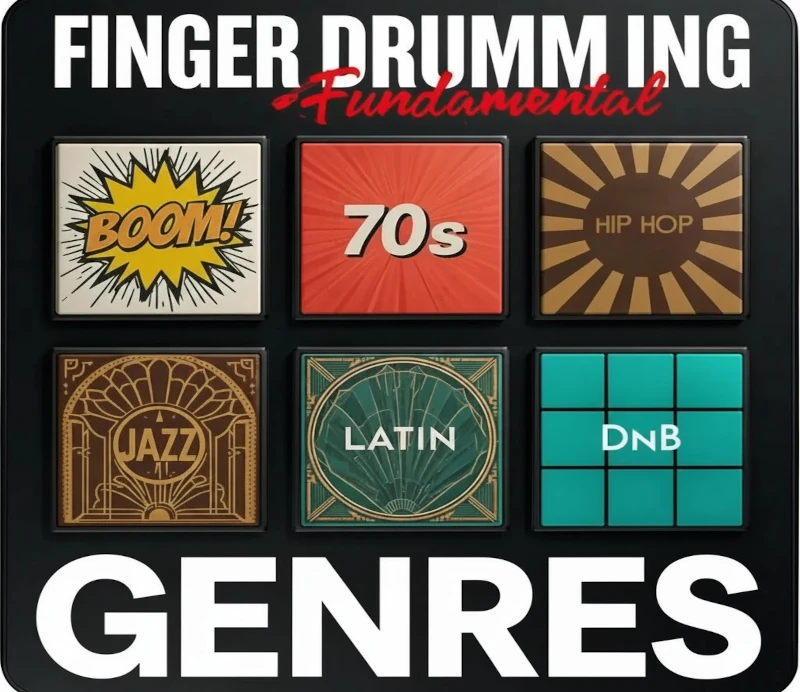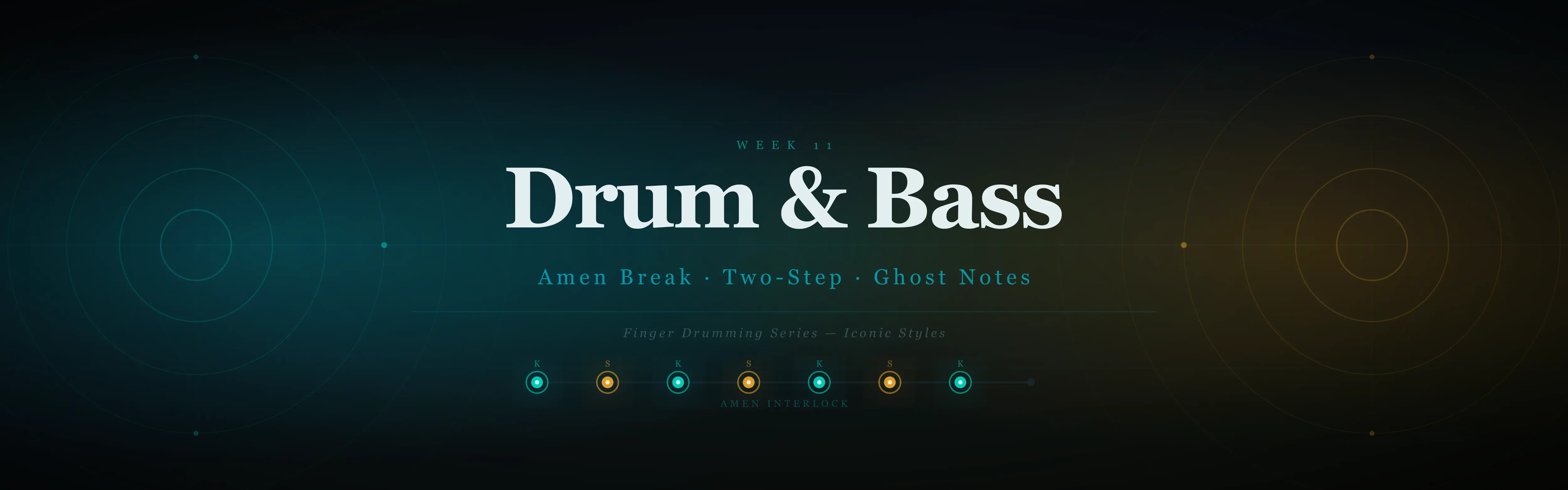
Every genre in this series has lived inside 4/4 — kick on 1 and 3, snare on 2 and 4, or some deliberate variation of that framework. Even the clave locked against a steady grid underneath.
Drum & bass doesn't do that. The two-step throws the kick off beat 3 entirely. The Amen break displaces the snare to positions that feel wrong until they don't. Everything you've built — syncopation, ghost notes, hand independence — now runs at 160–174 BPM. The technique is the same. The pressure is completely different.
What's Inside This Guide
🎯 Week 11 Warm-Up: Speed & Syncopation Preparation

D&B demands speed and precision simultaneously. These drills build both before the patterns arrive.
Warm-Up 1: 16th Hi-Hat Sprint
The floor of D&B is continuous 16th notes — 640 subdivisions per minute at 160 BPM. Before anything else, your dominant hand needs to sustain that without tensing.
What you're doing: Right hand only, 16th notes on PAD3 at 85 BPM. Push to 100 BPM only when fully relaxed — tension is slower, not faster.
Practice for 2 minutes. Wrist loose. Evenness at 85 BPM beats sloppiness at 100 BPM.
Warm-Up 2: The Two-Step Kick
The D&B kick abandons beat 3. It sits on beat 1 and the "and" of beat 2 — two hits in the first half, nothing in the second. That emptiness is part of the groove.
What you're doing: Kick on beat 1 (step 1) and "and" of beat 2 (step 7). PAD2 holds beat 3 as a fixed anchor so you can hear where the kick is not landing.
Practice for 2 minutes. Count beat 3 out loud even when nothing plays. That silence is the two-step's energy.
💡 Real Talk: The two-step kick feels wrong for the first 10 minutes. Keep counting, keep playing — it clicks right when you stop fighting it.
Warm-Up 3: Snare Displacement
D&B snares don't live on beats 2 and 4 — they get pushed to the "and" positions, between the beats. This drill trains your hands to land there comfortably.
What you're doing: Snare on the "and" of beat 2 (step 7) and "and" of beat 4 (step 15). Quarter-note kick on every beat as an anchor — so you always know where the beat is even when the snare avoids it.
Practice for 2 minutes. The snare should feel like it's leaning into the next beat. That forward lean is the breakbeat's defining tension.
🎯 What Is Drum & Bass?
Drum & bass emerged from the UK rave and jungle scene between 1992 and 1994 — producers like Goldie, LTJ Bukem, and Roni Size building on pitched-up breakbeats and sub-bass frequencies. The tempo settled at 160–174 BPM, the drums became the primary compositional element, and the genre redefined what a drum groove could do.
The rhythmic foundation is the two-step: kick on beat 1 and the "and" of beat 2, snare pushed off standard backbeat positions. Nothing lands where boom bap trained you to expect it. The groove works through that displacement.
The Amen break is the most sampled drum recording in history — a 6-bar drum solo by G.C. Coleman on "Amen, Brother" by The Winstons (1969). Recorded as a B-side, forgotten for two decades, then discovered by hip-hop DJs and later pitched to 160+ BPM by jungle producers. Its snare and kick land on positions that feel syncopated at any tempo. At D&B tempo they feel like controlled chaos.
The core challenge: kick and snare never anchor where this series trained you to put them. The patterns aren't hard to understand. They are hard to trust.
📚 Study These First
What to listen for: where the kick actually lands versus where you expect it, how the snare creates forward momentum by sitting between beats, and the relationship between the breakbeat chop and the bass.
- "Amen, Brother" by The Winstons (1969, ~138 BPM) — The raw break at its original tempo. Count where the snare lands — some hits are on the beat, others aren't. That irregularity is what jungle and D&B producers preserved when they pitched it up.
- "Inner City Life" by Goldie (1994, ~170 BPM) — The canonical D&B record. Two-step kick fully audible. Focus on beat 3 — its absence is the groove's personality.
- "Brown Paper Bag" by Roni Size/Reprazent (1997, ~172 BPM) — Amen break in full context. Snare displacement and ghost note layer clearly audible underneath the main hits.
Listen to "Amen, Brother" first, then "Inner City Life" — same break, 30 BPM faster, chopped and rearranged.
🥁 Pattern 1: The D&B Two-Step (Beginner)
The foundational D&B groove — kick on beat 1 and the "and" of beat 2, snare on beats 3 and 4, continuous 8th-note hats providing the rolling backdrop.
What you're learning:
- Two-step kick: beat 1 (step 1) and "and" of beat 2 (step 7) — two hits, first half only
- Snare on beats 3 and 4 — the second half carries the weight the kick vacated
- 8th-note hats as the continuous backbone at D&B tempos
Tempo: Start at 90 BPM. D&B runs 160–174 BPM — learn the shape first, push tempo over days.
Practice Strategy
- Kick alone — 3 minutes at 90 BPM. The two kick hits in the first half of the bar must feel natural before adding anything
- Kick + snare — snare on beats 3 and 4 fills the silence the kick left. This skeleton is the two-step
- Add hats — 8th notes provide the continuous flow everything sits inside
- Tempo push — add 10 BPM only when the previous tempo feels effortless, not when it's merely possible
💡 Key Insight: The two-step feels unbalanced because the kick loads the first half of the bar. That front-heaviness, combined with snare weight in the second half, creates D&B's driving forward momentum. Resist the urge to add a kick on beat 3.
🥁 Pattern 2: Amen Break Feel (Intermediate)
The Amen break's signature: kick and snare interlock on every 8th note — kick covers all four "and" positions plus beat 1, snare covers beats 2, 3, and 4. Nothing is on the same 8th note twice.
What changes:
- Kick: beat 1 (step 1), "and" of beat 2 (step 7), "and" of beat 3 (step 11), "and" of beat 4 (step 15)
- Snare: beat 2 (step 5), beat 3 (step 9), beat 4 (step 13)
Tempo: 100 BPM. Kick alone first — four hits, evenly spaced, before anything else.
Practice Strategy
- Kick alone — four hits: beat 1, and-2, and-3, and-4. 3 minutes until all four positions feel even
- Snare alone — beat 2, beat 3, beat 4. Straight on its own
- Kick + snare skeleton — every 8th note is covered by one or the other. That interlock is the Amen
- Full pattern with 8th hats
🎯 Advanced Challenge: Ghost Note Layer
Pattern 2 with ghost snares on the "e" of beat 1 (step 2) and the "e" of beat 3 (step 10) — the quiet hits that give the Amen break its textured, rolling density.
Only attempt this when Pattern 2 is clean at 100 BPM.
Ghost snares (PAD4) land immediately after beat 1 and immediately after beat 3 — right behind the kick hits, filling the space with the continuous forward roll that makes the Amen feel alive rather than mechanical.
📈 7-Day Practice Plan
Days 1–2: Two-Step Foundation
- Tempo: 85–95 BPM
- Focus: Warm-Ups 1 and 2 daily. Pattern 1 kick alone until the two-step displacement is automatic
- Goal: Full Pattern 1 clean at 95 BPM — the empty beat 3 feels intentional
Days 3–4: Pattern 2 Build
- Tempo: 95–105 BPM
- Focus: Snare displacement first — "and" of beat 4 in isolation before adding kick
- Goal: Pattern 2 skeleton (kick + snare) clean at 100 BPM
Days 5–6: Full Patterns + Tempo Push
- Tempo: 100–115 BPM
- Focus: Full Pattern 2 with hats. Attempt Advanced if Pattern 2 is solid
- Goal: Pattern 2 clean at 110 BPM
Day 7: Genre Rotation
- Tempo: 90–100 BPM
- Practice: 4 bars funk → 4 bars clave → 4 bars Afrobeats → 4 bars two-step. Continuous
- Goal: Five genres — clean switching between all of them
💡 Common Mistakes & Quick Fixes
Mistake #1: Adding a Kick on Beat 3
Problem: Muscle memory from every genre in this series puts a kick on beat 3. The two-step's empty beat 3 triggers an involuntary fill.
Fix: Warm-Up 2 daily. The fixed snare on beat 3 makes the silence audible. After two days the gap stops feeling like a mistake.
Mistake #2: Missing the Fourth Kick
Problem: The kick on the "and" of beat 4 (step 15) gets dropped — leaving only three kick hits and breaking the interlock with the snare.
Fix: Kick alone first, all four positions out loud. The fourth kick lands right before beat 1 of the next bar — once you feel that connection, it stops getting dropped.
Mistake #3: Tensing Up at Speed
Problem: As tempo climbs, wrists lock and the pattern collapses.
Fix: Drop 10 BPM whenever you tense. Speed is a side effect of efficiency, not effort.
Mistake #4: Ghost Notes Too Loud
Problem: Ghost snares at full volume make the pattern cluttered, not layered.
Fix: Ghost hits at 30–40% of main snare volume. If you can't tell them apart when listening back, they're too loud.
🔄 What You've Built This Week
- ✅ Two-step displacement — Kick on beat 1 and "and" of beat 2. The empty beat 3 is the groove
- ✅ Syncopated snare — Off-beat positions that create forward lean instead of backbeat anchor
- ✅ Amen break feel — Six-point kick and snare pattern capturing the break's defining character
- ✅ Ghost note density — Quiet hits underneath the main pattern adding texture without weight
- ✅ Five-genre vocabulary — Boom bap, trap, funk, Latin/Afrobeats, drum & bass. One year of global rhythm history in your hands.
🎯 Next Week Preview
Week 12 brings jazz brushwork and ride cymbal patterns — swing subdivision, jazz comping independence, and how the ride cymbal replaced the hi-hat as rhythmic anchor. The oldest genre in this series, and the one every other genre learned from.
Keep Warm-Up 2 in your routine. The two-step displacement compounds with repetition.
🎁 Free Practice Resources
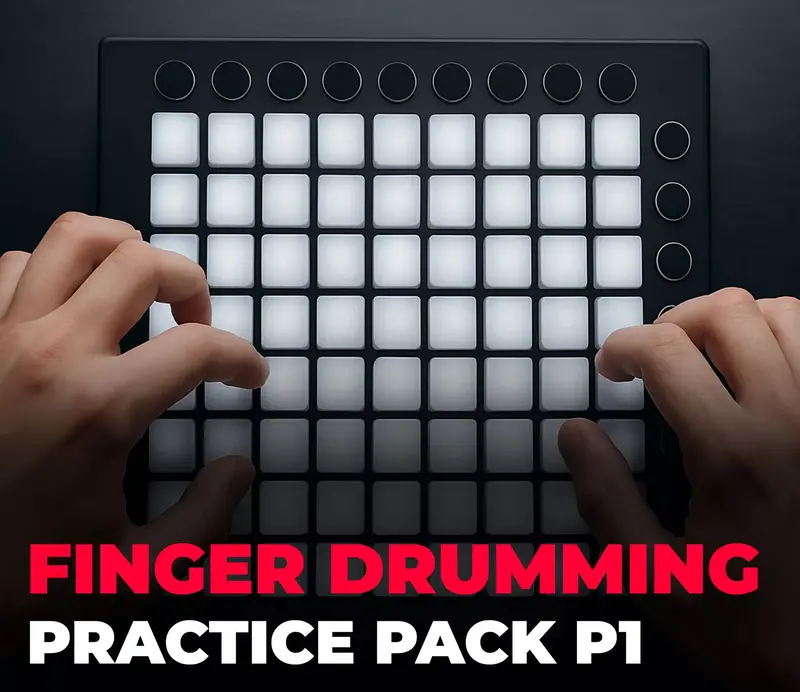
Eleven weeks in. Structured materials for Weeks 1–6 are in the free course below.
The break is 6 bars. G.C. Coleman recorded it in 1969 and never received a royalty. You are playing the most influential drum pattern in recorded music. Play it like you know.
— ToneSharp