A Note Before You Dive In: This post is heavier on neuroscience and clinical research than our usual tutorials — named studies, statistics, and cited sources throughout. It’s worth the slower read: understanding why your hands and brain respond the way they do is what makes the drills below actually stick, instead of just being another list of exercises to forget in a week.
You know the feeling. You chop a beautiful loop, lay your kits across the pads for a finger drumming session, click on the metronome, and get ready to perform it live. For the first eight bars, it’s clean. Then you push the tempo, try a faster variation, and everything falls apart — your hands seize up, you clip a pad you didn’t mean to touch, and your timing drifts somewhere it shouldn’t.
The usual advice is “just grind it out, put in your 10,000 hours.” Except that’s not quite how the brain works. Mindless repetition doesn’t sharpen your playing — it just as easily hardwires your mistakes as it does your skill. If you want faster hands and a tighter pocket — and hands that are still working the same way in ten years — you need to train the way your nervous system, and your tendons, actually respond. So let’s get into it.
What's Inside This Guide
What’s Actually Happening Inside Your Head and Your Forearms
Before the drills, it helps to know what’s turning the gears — both the mental kind and the musculoskeletal kind.
Myelination — building the highway Every time you hit a pad, an electrical signal races down a nerve fiber from your brain to your hand. Repeat a movement enough times, and your brain starts wrapping that fiber in a fatty insulation called myelin, which can speed up the signal by as much as 100x. This is “muscle memory” in the literal sense. When your fingers run through a 140 BPM trap pattern on autopilot while you’re mid-conversation with a friend, that’s a heavily myelinated pathway doing the work.
Intra-muscular inhibition — teaching your fingers to mind their own business When you tell your index finger to strike a pad, the signal doesn’t always stay contained — it can spill into your middle and ring fingers, making them twitch or tense. What separates clean players from sloppy ones is inhibition: your nervous system’s ability to send a “stand down” signal to every finger that isn’t supposed to move. This is the skill that lets your index finger slam a kick with real velocity while your ring finger hovers, completely relaxed, a millimeter above the hi-hat pad, waiting.
Desirable difficulty and interleaving — Robert Bjork’s research Cognitive psychologist Robert Bjork found that skills stick far better when practice feels frustrating in the moment. His concept of interleaving means switching between different tasks every few minutes — A, then B, then C — instead of drilling one thing for an hour straight (blocked practice). Sitting on one boom-bap loop for 40 minutes feels good, because eventually you stop making mistakes. But that ease is deceptive — a lot of that progress won’t survive the night. If you want it to stay with you, alternate: a boom-bap groove, then a fast triplet hi-hat roll, then a brand-new chop sequence, in short, slightly chaotic bursts.
Error tags — the Huberman and Ericsson angle Stanford neuroscientist Andrew Huberman points out that making mistakes isn’t a side effect of learning — it’s a prerequisite: “errors themselves are signaling to the brain and nervous system, something’s not working,” triggering a release of epinephrine and acetylcholine — alertness and focus, on demand. This connects to Anders Ericsson’s “10,000 hours” idea, which gets misquoted constantly. It was never about passive repetition. It’s about deliberate practice — the split second you botch a transition, your brain flags that pathway and starts working to correct it. The mistake is the signal.
NSDR — the save button The actual rewiring doesn’t happen while you’re playing. It starts the moment you stop. So instead of reaching for your phone the second a session ends, try sitting still — eyes closed, no input, five minutes — and let your brain do the part of the work that only happens in stillness.
Tendon gliding and the flexor/extensor balance Hitting pads leans heavily on your flexor muscles (the ones in your forearm that pull your fingers down and closed) and your extensor muscles (on the back of your forearm, snapping your fingers back open). Both sets pull on long tendons that run through narrow, lubricated sheaths in your wrist and hand. Finger drumming is high-velocity, high-impact work, and it stresses those tendons constantly. Train the downward strike and never train the release, and the two muscle groups fall out of balance — the tendons start rubbing against their sheaths instead of gliding cleanly through them, and that friction is where swelling and pain start. I noticed this firsthand switching from picking on guitar to striking pads on the Maschine MK3 — years of a metal guitarist’s fretting-hand grip strength did nothing to prepare my extensors for the release side of a fast pad pattern.


Why the 4x4 Grid Is Hard on Both Your Brain and Your Hands
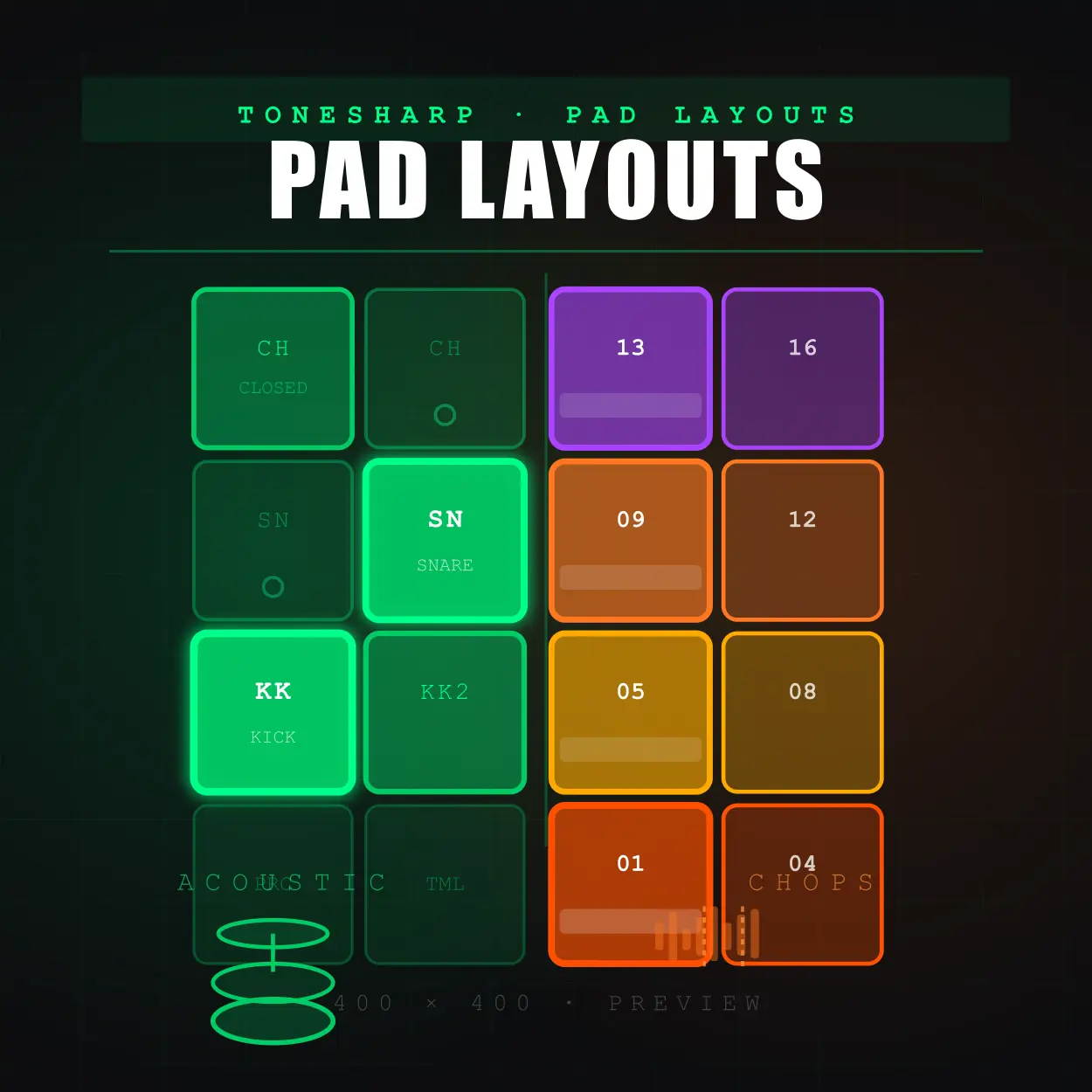
A pad controller isn’t linear the way a guitar neck or piano keyboard is. A 4x4 grid asks your brain to do spatial-coordinate mapping — every pad demands its own angle, its own pressure, and none of it looks like the pad next to it. If you’re still landing on a layout that fights this instinct, the pad layouts guide is worth sorting out first — a lot of the “hesitation” described below is really a layout problem wearing a technique costume.
So when you chop a new sample across 16 pads and try to arrange something live, your working memory has to juggle two demanding streams at once:
Push a complex chop pattern before that mapping is solid, and your brain redlines — forearms tense, hesitation creeps in, timing turns into rushing and dragging. And here’s the part that actually matters for your long-term health: the instinctive human response to that lag is to push down harder, to try to force your hands to keep up. Slamming pads at speed while your muscles are already tense is exactly the kind of load that leads to real injury. Separating the cognitive load from the physical one isn’t just a performance trick — it protects your hands.

The Finger Drummer’s Body: What the Research Actually Shows
Injuries tied to playing an instrument have a real clinical name: Playing-Related Musculoskeletal Disorders, or PRMDs. Research on this varies quite a bit depending on how a study defines “disorder” and which instrumentalists it looks at, but a widely cited review found “the point prevalence of the playing-related musculoskeletal disorders varied between 39 and 87%” across the musician population studied — a wide range, and higher than most people would guess, but consistent with other major reviews in the field, which report similar territory. The exact number depends heavily on methodology, but the takeaway holds up: playing-related pain is common, not rare, and it’s worth taking seriously before it starts rather than after.
For finger drummers and other electronic performers working fast, repetitive hand movements, three specific risks show up consistently in the literature:
1. Repetitive strain injury and tendonitis Continuous high-impact striking can cause small amounts of wear in the finger flexor tendons. Without enough rest and proper warm-up, that wear can outpace your body’s ability to repair it, leading to inflammation, localized heat, and aching pain. In practice, this tends to show up as a dull ache along the inner forearm, wrist soreness after only a few minutes of playing, or stiffness in the morning.
2. Carpal tunnel syndrome and nerve entrapment The median nerve runs from your forearm through a narrow tunnel of bone and ligament at your wrist before reaching your hand. If your wrists are bent or angled awkwardly while you play, and the tendons around them swell, that swelling can compress the nerve inside the tunnel. The result is a fairly distinctive pattern — shooting pain, burning, or numbness through the wrist, palm, thumb, index, and middle fingers.
3. Focal hand dystonia — “musician’s cramp” This one is rarer, and stranger. Under conditions of heavy, repetitive over-practice — often combined with significant stress — some musicians develop a neurological disorder where the brain’s map of individual fingers, in the somatosensory cortex, starts to blur together. A landmark brain-imaging study on affected musicians found “a smaller distance (fusion) between the representations of the digits in somatosensory cortex for the affected hand of dystonic musicians than for the hands of non-musician control subjects.” (Researchers don’t fully agree on the underlying mechanism — some recent studies argue the problem lies elsewhere in how the brain encodes skilled movement rather than in the finger map itself — but the practical effect is well documented either way.) What it looks like from the outside: your fingers involuntarily curl inward or claw outward the moment you try to play, with no pain at all, and no problem whatsoever when you’re not performing.
None of this is meant to scare you off the pads — it’s meant to make the case for training smart instead of just training hard.

The 4-Step Neuroplastic and Anatomical Drills
These pair well with the drills in the first 5 finger drumming exercises post — that’s the “what to play,” this is the “how to train it so it actually sticks and doesn’t wreck your hands.”
Drill 1: The Silent Map (fixes working-memory stutter)
Chop a sample loop across 8 pads.
- Map it (2 minutes): Hit each pad slowly, in order, eyes closed. Focus entirely on connecting the physical location of the pad to the sound it makes.
- Go silent (3 minutes): Kill your monitors or headphones completely. Set up a visual metronome — a flashing light works fine. Play your chopped pattern in total silence.
Without audio to lean on, your brain can’t cheat by using your ears as a crutch — it’s forced to rely entirely on spatial memory. When the sound comes back on, the hesitation is gone. Your fingers already know where to go.
Drill 2: Exaggerated Lifting and Antagonist Activation (fixes ghost triggers and flexor dominance)
Put a kick on Pad 1 (index), a snare on Pad 2 (middle), hats on Pad 3 (ring).
Play a simple groove slowly. Every time a finger finishes a hit, actively snap it a full one to two inches off the controller using the muscles on the back of your forearm, then let it go loose once it’s up. When it’s time to strike again, drop that finger with isolated speed, making sure the others don’t twitch along with it.
The real bottleneck in finger drumming usually isn’t how hard you can push a pad down — it’s how cleanly you can pull your finger back off it. This drill trains that release directly, and it keeps your flexors and extensors working in balance instead of one dominating the other.
Drill 3: The Gap-Click (fixes pocket and motor jitter)
Program a metronome, or a simple loop, to play for 2 bars and then drop out completely for 2 bars, while the project timeline keeps rolling underneath.
Play your sequence continuously through the silence. Don’t speed up. Don’t slow down. When the click comes back in on bar 5, check yourself: did your downbeat land right on top of it, or did you drift?
Missing the beat creates a small jolt of cognitive mismatch — that error tag from the section above — and your brain uses it to sharpen your internal clock for the next silent stretch.
Drill 4: Structural Micro-Slicing (fixes speed obstacles without tension)
Use this one when you hit a hard ceiling on a specific transition — a quick kick double, a fast three-pad roll, whatever keeps tripping you up.
Stop playing the full loop. Isolate just the two pads where your hand chokes. Adjust the tempo until you’re landing that transition successfully about 4 out of 5 times.
- Hitting it clean nearly every time? Speed it up — your brain has stopped learning at that tempo.
- Failing more than half the time? Slow down. You’re just rehearsing chaos at that point.

If Your Hands Are Already Talking to You
If you’re currently dealing with localized pain, numbness, or tightness, stop playing and take it seriously — these are common self-care adjustments, but they’re not a substitute for seeing a doctor or hand therapist if the pain persists or worsens.
1. Ergonomic angle adjustments Avoid practicing with your wrists bent down or twisted to the side. Your forearm, wrist, and hand should form a roughly straight, neutral line parallel to the ground. Propping your controller up slightly on a stand or tilted surface can help your hands land naturally without forcing your wrists into a bent position — see the stand options guide if you’re still playing flat on a desk.
2. Tendon-gliding exercises as a warm-up Tendon gliding is a well-established technique used in hand therapy, particularly for tendon and nerve issues like carpal tunnel. Before you touch your hardware, try this sequence: extend your hand flat, bend your knuckles forward into a “tabletop” shape, roll your fingers down into a loose fist, then slide your fingertips up your palm until your hand is flat again. Ten slow reps per hand.
3. Contrast temperature therapy — with a caveat Alternating hot and cold water immersion (a few minutes warm, then a shorter stretch cold, repeated a few times, ending on cold) is a technique used widely in hand therapy and sports recovery, and many people find it genuinely helps tight, achy forearms feel better. It’s worth knowing, though, that the research on why it works — and how much it actually accelerates healing versus simply feeling good in the moment — is mixed and not fully settled. Treat it as a comfort measure worth trying, not a guaranteed fix, and don’t let it substitute for rest or medical care if pain sticks around.

A Daily 30-Minute Routine
Don’t grind for hours until your wrists ache. This structure gets more out of less time, and protects your hands while it does it:
| Time | Phase | Focus |
|---|---|---|
| 0:00–0:03 | Priming & Warm-up | Tendon-gliding exercises, loose forearm stretches |
| 0:03–0:15 | Cognitive Load | Drill 1 or Drill 4 — your sharpest focus goes here |
| 0:15–0:25 | Contextual Integration | Drill 2 and Drill 3 — jam it out, test tempos, loosen up |
| 0:25–0:30 | Brain Save Block | Step away. Eyes closed, five minutes, total silence |
That’s it — the same 30 minutes you were already spending, structured around how your brain locks in skill and how your hands actually hold up over the long run. If you’re building this into a longer habit, it slots straight into the 15-minute daily practice routine — same structure, this is the biology behind why it works. And if you’re just getting your hands on pads for the first time, grab the Free Finger Drumming Fundamentals pack before you start layering in speed drills — clean fundamentals now means fewer bad habits to untrain later.
This article is for general education and isn’t a substitute for professional medical advice. If you’re experiencing persistent pain, numbness, or loss of control in your hands, see a doctor or a hand specialist.