Affiliate Disclosure: This post contains affiliate links. If you buy something through one of these links, I may earn a small commission at no extra cost to you. I only recommend gear I have actually used or would genuinely buy myself.
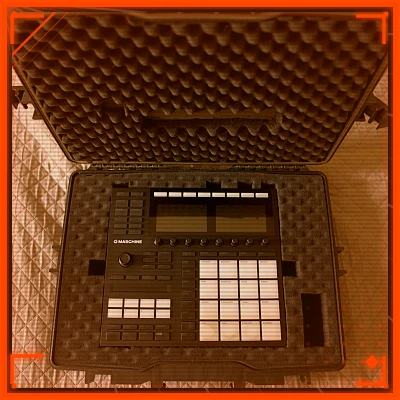
Last post I showed you how to build a custom hard case for the MK3. That post was about protecting the controller when it travels. This one is about protecting you while you play it.
Ergonomics is a real science — and finger drummers ignore virtually all of it. Here is an honest breakdown of every stand type I tested, what each one gets wrong, and why I ended up taking an angle grinder to an otherwise excellent piece of gear.
What's Inside This Guide
The Invisible Science — Ergonomics

If you sit at a flat desk and drum for a few hours a session, you are doing to your body what an office worker does staring at a monitor positioned too low — except it is arguably worse, because finger drumming involves hundreds of short, high-velocity impacts. The repetitive loading on your finger joints and wrists, combined with a neck perpetually cranked downward toward pads sitting flat on a table, compounds every single session until one day your neck reminds you in a very loud way.
The fix is almost embarrassingly simple: elevation. Raise the controller up and angle it toward you so your eyes meet the pads at a natural gaze and your wrists float rather than hinge. In a pinch, a stack of books works. But if you play seriously — daily practice, live sets, long studio sessions — you need a proper dedicated stand.
My Perfect Stand Checklist

Before spending a single euro, I wrote down exactly what a stand had to do. Not “nice to have” — hard requirements. Here is the list I measured everything against.
- Universal fit — must securely hold the Maschine MK3 as well as other grid controllers
- Standalone & mobile — easily moved around the room or transported without bolting to anything
- True hybrid height — low enough for seated sessions, high enough for standing play (I am tall — this was non-negotiable)
- Lightweight yet sturdy — enough mass to resist shifting during aggressive play, light enough to actually pack up
- Packable — lays flat or disassembles to a reasonable footprint for a gig bag
- Budget-friendly — high value without a boutique premium price tag
Keep this list in mind as we go through the options. It is the lens everything gets measured against.
Evaluating the 4 Types of Stands

Option A: The Sit/Stand Desk
For a long stretch, my motorized standing desk was my default finger drumming surface. In theory it is the perfect solution — infinite height range, rock-solid stability, and it already lives in the studio. I was getting my standing steps in, the height micro-adjustment was exact, and I did not need to buy anything new.
Then reality set in. Lowering and raising a full motorized desk just to switch between sitting and standing play is tedious in a way that is hard to appreciate until you do it thirty times a week. And the deal-breaker for late-night sessions: the motor hum. When your room is quiet and you are working on a delicate groove at low volume, the mechanical whir of the desk cycling through its height range is genuinely disruptive.
The desk works. It is just overkill for this specific job, and the friction of using it eventually makes you stop using it.
My pick: Huuger 55 x 28 Large Electric Standing Desk
Alternatives worth considering:
- Standing Desk, Height Adjustable Electric Stand up Desk
- Small Electric Stand Up Desks
- HUANUO 32” Small Electric Standing Desk
Option B: Dedicated Maschine / Desktop Wedge Stands
These are the stands that show up in every Maschine unboxing video — fixed angled wedges, typically set between 30 and 45 degrees, machined from wood or aluminum, often with the NI logo laser-etched into the side. They look clean. They feel premium. And if you use the Maschine primarily as an in-the-box production tool, sitting at a desk, running software, they are a decent fit.
For dedicated, high-intensity finger drumming, they fall short fast. The angle is fixed. If it does not suit the way you sit or the height of your desk, you are stuck — there is no adjustment. Worse, they are desktop accessories by design, which means you are always tied to a desk surface unless you buy a separate mounting arm, at which point you have spent more money than necessary. Great for the producer who plays pads casually as part of a broader DAW workflow. Too limiting for anything else.
My pick: Musiin Drum Controller Foldable Stand
Alternatives worth considering:
- Musiin Custom Adjustable Drum Controller Stand
- Laptop Stand for Desk, Adjustable Laptop Riser
- Gravity GLTS01B Adjustable Laptop & Controller Stand
Option C: Acoustic Drum Hardware — Snare & Tom Stands
This one required actual field research. I drove to a local music shop and spent an afternoon physically testing standard acoustic drum hardware with a controller to see if it could work.
The stability on both a standard snare stand and a long floor tom stand was remarkable — these things are built to absorb thousands of full-weight drumstick hits, so a finger drummer hammering pads registers as basically nothing. The snare stand felt great for seated play but lacked the maximum height needed for standing. The tom stand solved the height problem entirely. But both shared a flaw I had not anticipated: the basket arms and clamps reach up past the base plane of the instrument. Even trimmed down, those heavy steel brackets are thick enough to obstruct cable ports and create an awkward physical interference with hand placement. I left without buying anything.
The exception is the Gibraltar Stand. I could not test it in-store, but its mounting plates and arms are visibly slimmer than anything in the standard hardware lineup. Feedback from other controller players who use it is consistent: it is an absolute tank, it clears the cable ports, and it holds position through aggressive play. If you are committed to drum hardware as your platform, start here.
If you go the acoustic route, you have to be incredibly careful with the basket size and its adjustment mechanism; standard snare baskets are often too bulky, meaning the rubber grips will choke your controller’s side ports or overshoot the face of the pads entirely.
My pick: Gibraltar Electronic Drum Mount Station
Alternatives worth considering:
- Gibraltar 8713UA Ultra Adjust Flat Base Tom/Snare Basket Stand
- Tama The Classic Series Single Tom Stand
- HAIRIESIS Snare Drum Stand Double Braced Adjustable Snare Stand
Option D: Heavy-Duty Laptop Stands — The Winner
This category surprised me most. Laptop stands are not designed with finger drumming in mind, but the design requirements overlap almost perfectly: a rigid, elevated platform at variable height that packs flat and does not weigh a ton. The market is flooded with options at every price point, and the best of them are exceptionally rigid, fold completely flat for transport, and deploy in seconds.
The only meaningful catch is that the front safety lip or locking mechanism on some models can physically interfere with wider controller footprints — worth checking the platform dimensions against your specific controller before committing.
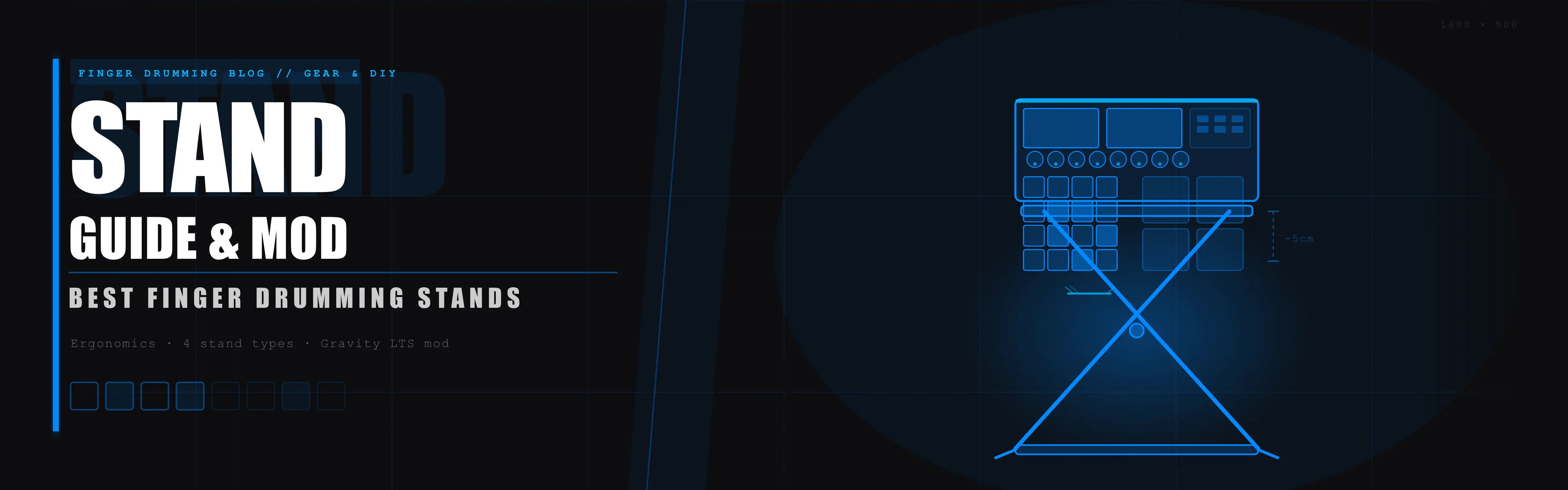
My choice after testing several was the Gravity LTS Laptop Stand. It checked every box: robust aluminum construction, smooth telescoping height adjustment, folds flat in about three seconds, and handles the MK3’s footprint cleanly. There was exactly one problem — out of the box, the minimum height was still a few centimeters too high for a truly relaxed seated position. I’ll explain what I did about that in the next section.
My pick: Gravity Laptop Stand LTS T 01 Adjustable Laptop Stand
Alternatives worth considering:
- On-Stage LPT7000 Deluxe Laptop Stand
- Amazon Basics Adjustable Height Portable Laptop Tripod Stand
- K&M Konig & Meyer 12185.000.55 Laptop Stand
Hacking the Gravity LTS — Enter the Angle Grinder


Here is the thing about finding gear that is 95% perfect: you have two choices. Return it and spend another month searching for something marginally better that probably does not exist. Or fix the 5%.
I chose option two and went to the garage.
The modification was simple. The minimum height was sitting about 5 cm too high for my ideal seated position. The solution: remove exactly that amount from the structure. I marked all base feet at 5 cm from the bottom, clamped each one securely, and made a clean cut with the angle grinder. Then I did the same to the primary vertical support pipe — shortening it by 5 cm to keep proportions consistent and preserve the full telescoping range for standing height.
Total time in the garage: about 25 minutes including cleanup.
The minimum height now drops right into the sweet spot for seated play — arms relaxed, wrists neutral, eyes on the pads without tilting my neck forward. The full telescoping range is still intact for standing sessions. I have not found a single performance downside since making the cut.
My one minor critique — and it is genuinely minor — is that the top platform could use a few more pre-drilled holes for zip-tie or bolt mounting points. I will likely just drill those myself next weekend. At that point it will be truly perfect.
One note before you reach for the grinder: this absolutely voids the warranty. For average-height players, the stock Gravity LTS may already sit at the right height. Measure before you cut. And when you do cut — clamp it properly, go slow, and sand the edges clean afterward.
The Final Verdict

Flat desk finger drumming is cheap in the short term and expensive in the long term. The cost is not in your wallet — it is in your neck and wrists and eventually your ability to play comfortably at all.
For most finger drummers, start with the Gravity LTS Laptop Stand. It wins on packability, adjustability, build quality, and price-to-performance. Average-height players may find it perfect straight out of the box. If you are tall and mechanically comfortable, the 5 cm mod described above takes it from great to genuinely perfect.
If you want a no-compromise freestanding solution and do not mind some extra weight, the Gibraltar Gems Electronics Stand is worth a serious look — it is built like drum hardware because it is drum hardware, and the slim arm design actually clears the cable ports cleanly.
Whatever you choose: get the controller off the flat desk. Your body will notice within a week, and your playing will follow.
What stand are you currently using? Have you run into ergonomic pain from bad controller placement? Or have you already gone the DIY route and modded your own studio furniture?
Related
- 30 Days of Finger Drumming Practice: What Changes
- Launchpad and Maschine Setup for Finger Drumming
- 15-Minute Finger Drumming Practice Routine
Protect your neck. Elevate your pads. Play longer.
— ToneSharp