An hour of unfocused playing doesn't make you better. It makes your bad habits faster.
Most people who pick up a pad controller hit the same wall: they play for a while, nothing clicks, and they assume the problem is talent or time. It isn't. The problem is structure. If you are wondering how to practice finger drumming effectively, the answer is not more hours — it is the right finger drumming daily practice structure applied consistently. This guide gives every finger drumming beginner that structure, and fixes the stagnation that hits a few months in.
What's Inside This Guide
How to Practice Finger Drumming: The Core Problem
Before covering the finger drumming practice routine itself, it’s worth naming why most pad players stagnate. Unstructured practice reinforces whatever you already do — including the mistakes. If your hi-hat rushes every time you add a snare, 60 minutes of unstructured playing bakes that rush deeper into muscle memory. Structure is what separates practice from playing around.
The 15-minute finger drumming practice routine below is divided into three parts. The time split is deliberate — each part has a different purpose, and changing the proportions breaks the system. Think of this as your 15 minute practice routine for drums: short enough to commit to every day, structured enough to produce results.
5 Minutes: Warm-Up

The warm-up is single strokes at 60 BPM. Left-right-left-right, alternating hands, consistent velocity. Nothing more complex than that. This is not the place to work on patterns — it is the place to wake your hands up and check their condition before asking them to do anything difficult.
What you are listening for during the warm-up: is your non-dominant hand quieter than your dominant hand? Is it landing slightly late? Is there a gap between your two hands that wasn’t there yesterday? This five minutes is as much diagnostic as physical. The information you gather here should shape what you focus on in the seven minutes that follow.
Practice for 5 minutes. Every hit should be the same weight and tone. Unevenness is information — notice it without judgment and use it to choose your focused drill.
7 Minutes: Focused Drill

This is the core of any effective finger drumming practice routine. One exercise. One rhythm. No switching. Pick the specific thing you are currently failing at — the pattern where your hands fall apart, the fill you keep dropping, the coordination that isn’t clicking — and spend seven consecutive minutes there.
The temptation when it gets frustrating is to change exercises. That frustration is exactly the signal to stay. Improvement happens at the edge of what you can currently do. Seven minutes of focused struggle on the right thing is worth more than an hour of comfortable repetition on patterns you already own.
For pad controller beginners, the correct starting drill is kick on beats 1 and 3 with continuous 8th-note hi-hat. Two elements only. The goal is not to make it sound complicated — it’s to make the two elements run independently, so adding a third one doesn’t destabilise the other two.
Practice for 7 minutes. Start at 70 BPM and apply the tempo rule in the next section before pushing the speed higher. If the kick starts affecting the hi-hat's evenness, drop the tempo and rebuild from there.
💡 Key Point: Improvement in finger drumming happens at the edge of what you can currently do — not inside the patterns you already own. Seven minutes of genuine struggle beats an hour of comfortable repetition.
3 Minutes: Groove

Play something fun. Your favourite beat, a pattern you know cold, free improv over a backing track at whatever tempo feels good. The final three minutes of every finger drumming session are not practice in the conventional sense — they are the reward for the seven minutes before them, and a daily reminder of why you picked up the pads.
Ending every session sounding good to yourself is not indulgent. It is psychologically essential. The brain needs to associate the pad controller with positive experiences or the habit breaks down. This is what makes the three-minute groove the anchor of any finger drumming daily practice routine — it closes on a high, so you come back tomorrow. Groove for three minutes, enjoy it, then stop.
The Tempo Rule
The single most common mistake in any 15-minute finger drumming practice routine — and in longer sessions — is starting at the tempo where you want to play instead of the tempo where you can play cleanly. Learning how to practice finger drumming correctly means confronting this instinct every session.
The rule is simple and non-negotiable. Start 10–15 BPM below the speed where the pattern feels comfortable. If something feels easy at 90 BPM, start at 75. Play it there until you hit ten consecutive clean repetitions — no rushing, no flams, no dropped notes. Only then move the metronome up by 5 BPM. If you make a mistake at any point, reset the count. Ten consecutive clean reps, not nine clean and one sloppy.
60 BPM feels embarrassingly slow. It is also where your hands actually learn the pattern correctly. The muscle memory built on the pad controller at 60 BPM is the same memory used at 120 BPM — the substrate is identical. If that foundation has timing gaps or inconsistent velocity at 60, the higher tempo doesn’t fix those gaps. It just makes them faster.
The exercise below is the same kick-and-hat drill from the focused drill section, now at 60 BPM. Try it. Notice how different “clean” feels at this tempo versus 70 or 80. This is the baseline standard — everything built on top of it has to meet this same clarity.
Once this feels trivial at 60 BPM, move to 65. Then 70. The tempo rule applies at every stage — ten clean reps before moving up. This is the foundation of any effective 15-minute practice routine for drums or pads. The standard is the standard, regardless of how slow it feels.
What to Practice Each Week

The focused drill section of your finger drumming practice routine only works if you know what to put in it. The progression below moves in the correct order — each stage builds the specific physical independence that the next stage requires. Skipping ahead breaks the system because the later stages assume the earlier ones are already automatic.
Weeks 1–2: Hi-Hat and Kick Coordination
Right hand on the hi-hat, left hand on the kick pad. The goal for a finger drumming beginner at this stage is simple two-limb independence: hi-hat running as steady 8th notes, kick landing on beats 1 and 3, without the hi-hat flinching when the kick hits. This sounds basic. It is not. The hi-hat will react to the kick — it’s the natural default before independence is built. All of your practice in these two weeks goes toward making the hi-hat completely indifferent to whatever the kick hand is doing.
For the full set of exercises for this coordination stage, see the Rudiments Part 1 post which covers the specific drill progression in detail.
Weeks 3–4: Adding Snare on 2 and 4
Once kick and hi-hat run without conscious thought — once the hi-hat doesn’t react to the kick and the kick doesn’t react to the hi-hat — the snare joins on beats 2 and 4. You now have three simultaneous layers. The same independence principle applies: the snare must not cause the hi-hat to rush, and the hi-hat must not cause the snare to lag. Each layer is autonomous.
This is the stage where most pad controller beginners experience the clearest breakthrough. When three limbs suddenly coordinate without fighting each other, the groove locks and it sounds like actual music for the first time. It always happens later than expected and more suddenly than expected. The Week 1 and Week 2 posts in the fundamentals series contain the graded exercises for this stage.
Month 2 and Beyond: Ghost Notes and Syncopation
Once the basic three-limb groove runs clean at tempo, the next level of the finger drumming practice routine introduces dynamics and rhythmic displacement. Ghost notes — snare hits at 20–30% velocity — sit underneath the main snare backbeat, adding texture without weight. The kick begins landing on syncopated positions like the “and” of beat 2, creating the forward momentum that characterises professional grooves.
This stage is where finger drumming stops sounding like exercises and starts sounding like music. The ghost notes are below the threshold of conscious hearing for most listeners — they feel the result (a richer, more human groove) without being able to identify the cause. Keep ghost hits at 20–30% of your main snare volume. If a listener can clearly identify them, they are too loud.
Ghost snares (PAD4) land on the "e" of beat 1 and the "e" of beat 3 — the 16th note position immediately after each beat. Kick now sits on beat 1 and the "and" of beat 2. Apply the tempo rule at every stage: 85 BPM is the target, not the starting point.
🎁 Free Practice Pack
The 15-minute finger drumming practice routine above needs structured material to work with. I built a free 17-exercise practice pack designed specifically as a 15 minute practice routine for drums and pad controllers — an interactive pad player that shows you exactly when each hit lands, sheet music, MIDI files, and both Ableton and Maschine templates pre-loaded with the correct drum sounds.
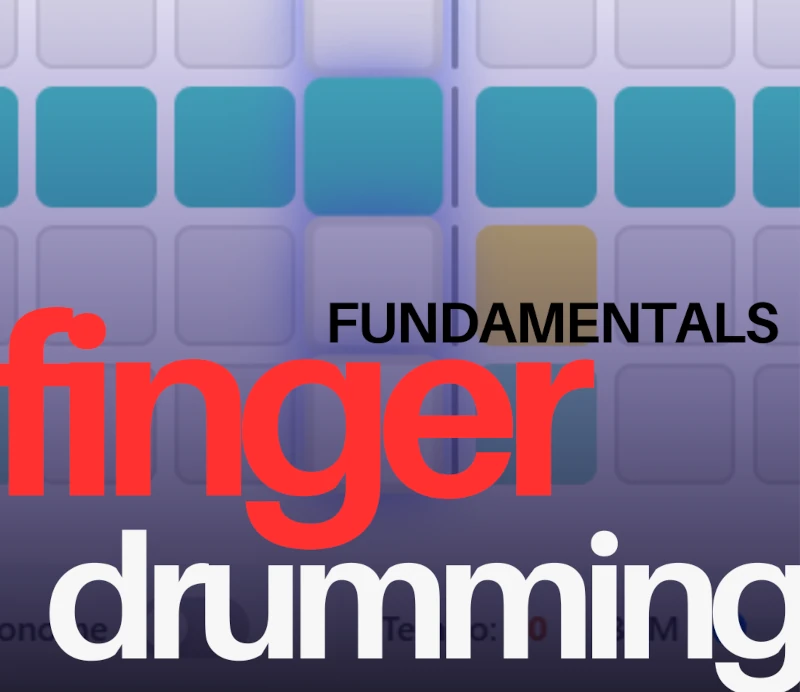
Download Free Finger Drumming Fundamentals — drop your email and it’s yours instantly. If you want more structured lesson packs beyond the fundamentals, the full catalogue of Free Finger Drumming Lessons
Related Posts
- Week 1 — First Week of Finger Drumming
- Week 2 — Warm-Up and Beginner Beat Patterns
- Rudiments Part 1 — Core Exercises
- Intro to Metronome Exercises - Train Your Inner Pulse
- Realistic Finger Drumming Groove Series
Fifteen minutes. Three parts. One rule about tempo. The pad is already on your desk — use it properly.
— ToneSharp