Two minutes sounds like nothing until it’s your two minutes. Say it out loud in your bedroom and it feels generous. Stand under stage lights with a bracket sheet on the wall and a judge’s stopwatch already running, and it turns into the longest two minutes you’ve ever played.
Nobody on this site has actually addressed that gap. The rolls post, the ghost-note terminology in Week 6, the sample-chopping guide, the pad layouts breakdown — all of it hands you material. The live-set post before this one showed you how to arrange that material for a room that isn’t scoring you round by round. A battle routine is a different animal: fixed time, a panel judging specific things, one shot before you’re through to the next round or done for the day.
What's Inside This Guide
- Why Two Minutes Feels Like an Hour
- What Judges Are Actually Scoring
- Structuring Your Two Minutes: Statement, Build, Showcase, Peak, Resolution
- The Technical Showcase: Rolls, Ghost Notes, and Chops
- Genre-Hopping vs. Staying in One Lane
- Rehearsing Like the Clock Is Real
- Rookie Mistakes That Cost Rounds
- Where to Actually Enter
Why Two Minutes Feels Like an Hour
Start with the actual numbers instead of guessing at “showmanship.” The Yamaha FGDP Competition, held at 2025’s Sample Music Festival in Berlin, ran exactly this format: a 2-minute solo, pad sounds only, no loops. Sample Music Festival’s own Finger Drumming World Championship rules page — the competition this has run under since at least 2021 — is even more specific: 2 minutes per round, knockout bracket, a jury picks the top 3 for a finals round that adds another 2-minute showcase. Competitors are told to bring roughly 10 minutes of prepared material, because you won’t know which 2 minutes you actually need until you’re standing on stage.
The gear cap is real too, and it matters more than it looks: a maximum of 2 controllers — pad or MIDI — plus a laptop. My own rig is a single Maschine MK3. Bringing a Launchpad along just to look impressive would already have me flirting with that limit for no real payoff. A routine built around one solid controller reads cleaner to a judge than one built around switching rigs mid-set.
That’s the actual constraint this post is solving for: not “how do I play well,” but how do you compress everything you can already play into something that survives a stopwatch, a knockout bracket, and a room that’s only watching you once.
What Judges Are Actually Scoring
The Sample Music Festival rules page names six criteria directly, and every one of them turns into something concrete you can check your routine against rather than vague stage presence:
- Musicality — does the routine feel like a piece of music, not a technique reel stitched together with no connective tissue?
- Sample choice — for a chop-based section, does the material itself sound intentional, not just whatever loaded fastest?
- Harmony & tone — do the sounds you’ve picked actually sit together, especially if you’re genre-hopping (more on that below)?
- Performance technique — the rolls, the ghost notes, the finger choreography — the part most players over-prepare for at the expense of everything else on this list.
- Timing — not just “in the pocket” during the groove sections, but landing your transitions on the beat you meant to land them on.
- Creativity — the one axis that actually rewards a genuine idea over a technically flawless copy of something you’ve seen on YouTube.
Notice technique is one item out of six, not the whole scorecard. A player with clean rolls and no arc loses to a player with a real arc and merely solid technique, every time a judge is actually following this rubric.

Structuring Your Two Minutes: Statement, Build, Showcase, Peak, Resolution
Five moves, in order, and each one earns its place against the criteria above:
- Opening statement (0:00–0:15). Establish groove and identity immediately — this is where “musicality” gets decided in the judges’ heads before you’ve played your hardest material.
- Build (0:15–0:45). Add layers, raise density, signal that something bigger is coming.
- Technical showcase (0:45–1:20). Your rolls, ghost notes, and chops — covered in full below.
- Peak (1:20–1:40). The loudest, densest, most confident moment of the routine.
- Resolution (1:40–2:00). Land it. A routine that just stops when the clock runs out reads as unfinished; one that resolves on purpose reads as composed.
Here’s an opening statement built around exactly that first move — sparse enough to breathe, confident enough to say “I know where this is going”:
The transition points between these five moves are the actual craft here, not the moves themselves. Week 5’s Fills & Transitions post already covers fills as punctuation rather than decoration — that vocabulary is exactly what carries you from build into showcase and from peak into resolution. Don’t re-invent it here; reuse it.

The Technical Showcase: Rolls, Ghost Notes, and Chops
This is the internal-linking hub of the whole post, on purpose: don’t invent new material for a battle routine. Cash in what you’ve already drilled.
Ghost notes first. The accent-versus-velocity distinction from Week 6’s terminology post and the ghost-note groove from Week 4’s timing & syncopation post both apply directly here — a judge scoring “performance technique” is listening for exactly this kind of controlled dynamic contrast, not just raw speed:
Then the roll, straight out of Hi-Hat Roll Mastery — same burst-length and velocity-shaping principles that post already taught, just placed where it does the most damage: right before the peak.
If sample chopping is part of your style, the Sample Chopping guide is where “sample choice” — one of the six scored criteria — gets decided weeks before you ever step on stage. A chop that sounds intentional under a judge’s ear started as a deliberate choice in your own session, not whatever loaded fastest the night before.

Genre-Hopping vs. Staying in One Lane
Staying in one lane — pure trap, pure boom bap, pure drum & bass — reads as more cohesive against the “harmony & tone” criterion. Everything sits together because it was never asked not to.
Genre-hopping scores higher on “creativity” when it lands, and considerably worse when it doesn’t. Two minutes isn’t much room to justify a hard left turn, and a judge who’s unconvinced by the jump will mark it down on tone even if the individual sections were both clean.
The honest recommendation: stay in one lane for your first routine. Get the five-move arc from the previous section rock solid first. Genre-hopping is a second-routine move, once you already know your transitions can carry a change that big.
Rehearsing Like the Clock Is Real
Rehearsal for a timed routine is a different discipline than practicing a pattern until it’s clean. Three habits actually move the needle:
- Record every run. Phone camera, no exceptions. What feels tight in the room and what actually sounds tight on playback are two different things, and you only find out which is which by watching it back.
- Cut dead space ruthlessly. Any pause that isn’t a deliberate resolution beat is time you’re not getting back. A routine that’s 15 seconds too long doesn’t get graded on the extra 15 seconds — it gets cut off.
- Time it to the actual second, not “about two minutes.” The SMF rules explicitly recommend having a backup routine ready in case of a tie — rehearse that one on the clock too, not just your main set.
One honest caveat worth saying out loud: drilling the same two minutes daily under time pressure is exactly the kind of repetitive load the injury-prevention post is about. Build recovery into rehearsal weeks, not just into your practice weeks.

Rookie Mistakes That Cost Rounds
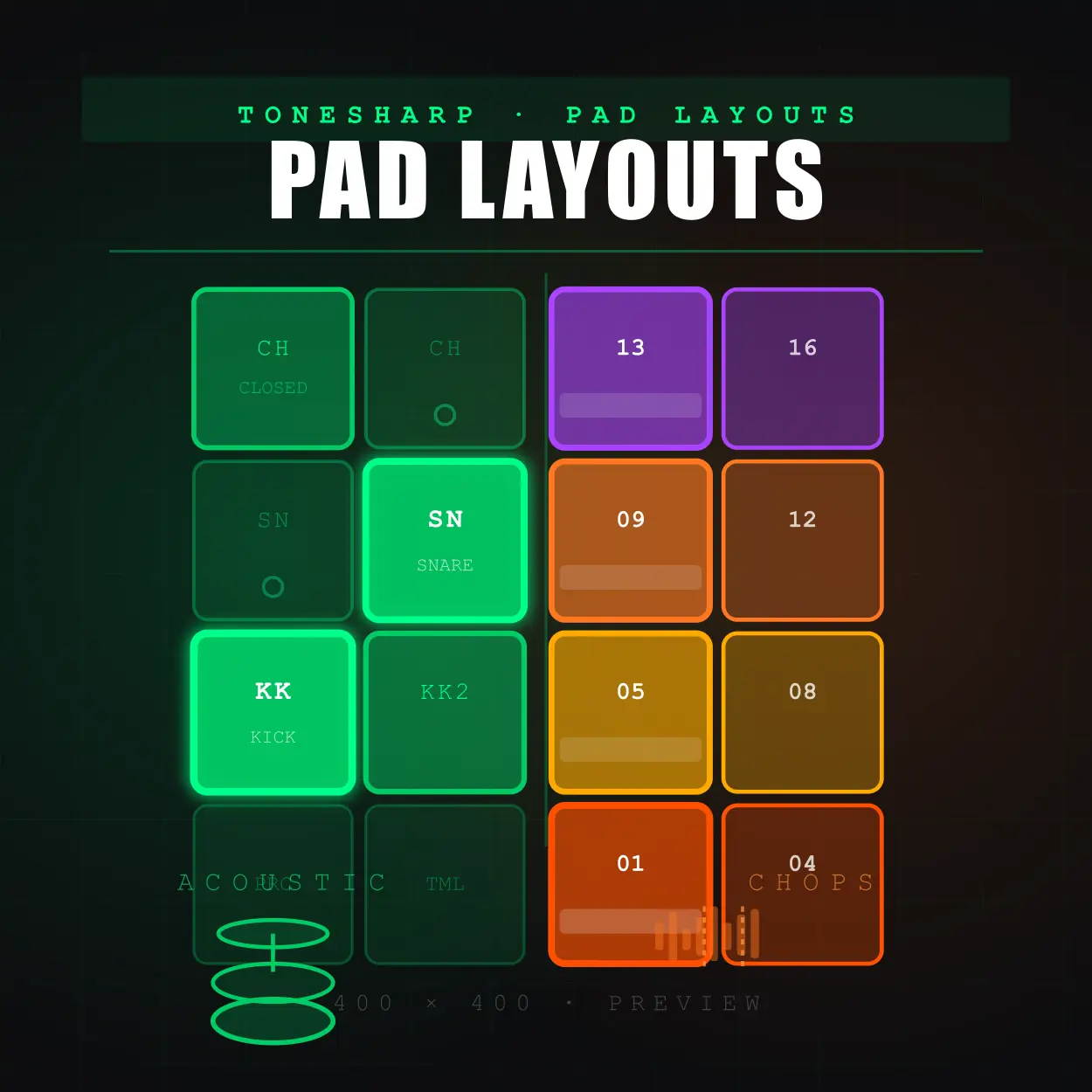
- Over-relying on one pad-layout trick. If your whole routine leans on a single configuration, revisit the Pad Layouts guide — there’s a wider menu of options than most players ever touch.
- No dynamic contrast. Straight back to the “timing” and “musicality” criteria above — a routine that’s loud and dense from second one has nowhere left to go for the peak.
- Ignoring the sightline. Judges and crowd both need to see your hands doing something, not just hear it. Face your rig so the moment you’re proudest of is actually visible.
- Burning the whole two minutes on the showcase. No opening statement, no resolution — just technique from start to finish. It reads as a demo reel, not a routine, and it scores like one.

Where to Actually Enter
The real, currently-documented option is Sample Music Festival’s Finger Drumming World Championship — a recurring competition with editions confirmed in 2021, 2023, and 2025. As of this writing there’s no confirmed 2026 date yet, so check samplemusicfestival.com directly rather than this post for the current year’s entry window.
If your rig leans more sampler than pad controller, King of Flip, run by MPC Square Japan, is a live sampler battle built around a similar no-safety-net constraint — no sequencer, no play button, everything triggered by hand.
Beyond the two of these, the wider battle scene has a history of one-off events that came and went — worth knowing about as culture, not worth building your entry plan around.
Need material to rebuild your technical showcase from the ground up before your first routine? Finger Drumming Rudiments Exercises Part 1 is free, and if working through the showcase section above exposed gaps in your rolls or ghost-note control, that’s exactly what it’s built to fix.
Two minutes is still nothing. But it’s a different kind of nothing once you’ve actually built something to fill it.